
[vc_row type=”in_container” full_screen_row_position=”middle” scene_position=”center” text_color=”dark” text_align=”left” overlay_strength=”0.3″][vc_column column_padding=”padding-5-percent” column_padding_position=”all” background_color_opacity=”1″ background_hover_color_opacity=”1″ column_shadow=”none” width=”1/1″ tablet_text_alignment=”default” phone_text_alignment=”default” column_border_width=”none” column_border_style=”solid”][vc_column_text]Introduction
PROBE is a proven methodology that will demonstrate how business practices are driving company performance across a demanding scorecard of performance measures. It provides positive business returns through identifying actions that directly link internal activities to customer satisfaction and retention and ultimately to profitability.
The PROBE benchmarking tool is universally applicable, able to be used by any business or organisation that wishes to submit the way it operates and the results it achieves to scrutiny and challenge.
It is a powerful best practice benchmarking and assessment tool, powered by data from over 8,500 business users in 60 countries.
A first stage for a company on its journey to excellence is to assess its current position. How well does it measure up against its peers and how is it perceived in the eyes of its customers and employees?
Undertaking a PROBE benchmark and acting on its findings can achieve:
- A rapid identification of strengths & weaknesses for practical improvements
- Improved Customer Service and Employee Morale
- Greater Customer Satisfaction and Retention
- Reduction in staff absenteeism and an increase in productivity
- A competitive advantage and greater profitability
[/vc_column_text][toggles style=”default”][toggle color=”Default” title=”How PROBE works”][vc_column_text]The PROBE methodology combines several key components
- A skilled and knowledgeable organisational development adviser, trained as a PROBE facilitator
- A PROBE questionnaire. Each question addresses a particular aspect of organisational practice or performance, inviting you to rate your organisation against descriptors of best practice
- A team of colleagues who work within the client organisation, representing a range of roles and perspectives so that collectively they have a wealth of experience and insights into how the organisation works and what it achieves.
- The PROBE facilitator works with this team, leading an in-depth discussion of each question in the context of the team’s organisation.
- The PROBE Analytical Tool, enables the facilitator to analyse the data (the output of the team’s discussion), producing graphics and reports to shape action plans to address the shortcomings identified.
- After an appropriate time period during which the improved performance is expected to be realised (12, 18 or 24 months), the process can be repeated as part of a continuous improvement cycle of activities.
More Information
Download Probe Network “PROBE Explained” [pdf 994KB][/vc_column_text][/toggle][toggle color=”Default” title=”Probe Tools”][vc_column_text]The PROBE system exists at different levels, representing three different stages of maturity on the journey to sustainable excellence, and/or three different stages of readiness / preference for the depth of PROBE analysis.
- Lite: The ‘Lite’ version as the name suggests is a light-touch introduction to the PROBE methodology. It is designed for any organisation that will benefit from a quick, simple assessment providing an overview of its strengths and improvement opportunities. The questionnaire is short, typically 24 questions. The engagement is flexible to suit the context, the business adviser may work one-to-one with an individual representing the business, or perhaps with a very small group. The analysis is less in depth than at the ‘Standard’ and ‘Advanced’ levels.
- Standard: The ‘Standard’ version is designed for any organisation that will benefit from a quick and straightforward yet thorough assessment providing an overview of its strengths and improvement opportunities. The questionnaire contains typically 36 questions, it requires the full team approach and produces a thorough benchmarking analysis.
- Advanced: The ‘Advanced’ version is designed for any organisation that has made substantial advances on its journey to excellence and will benefit from a challenging, assessment of its strengths and opportunities for further improvement. It is the most stretching and contains 48 team questions and requires more input from the organisation’s PROBE team.
 [/vc_column_text][/toggle][toggle color=”Default” title=”Probe System Questionnaires”][vc_column_text]We use two variants of the Probe System
- The Probe Questionnaire
- The Probe for Manufacturing Excellence Questionnaire
1.The Probe Questionnaire, this is applicable to any business, any organisation of any size and type in any sector. It is available at three different levels, Lite, Standard and Advanced.
Probe Questionnaire Advanced Version – Sections & Question Titles
The ‘Standard’ & ‘Lite’ Versions are composed of a subset of this listing.
| Section | Question# | PROBE Advanced | Practice or Performance |
|---|---|---|---|
| Develop Vision & Strategy | 1 | Leadership for sustainable excellence | Practice |
| 2 | Customer and process focus | Practice | |
| 3 | Developing vision and strategy | Practice | |
| Develop & Manage Markets, Products & Services | 4 | Market and sell products and services | Practice |
| 5 | Listening to the customer | Practice | |
| 6 | Develop and manage products and services | Practice | |
| Financial Perspective | 7 | Key results for financial stakeholders | Performance |
| 8 | Cash flow | Performance | |
| 9 | Market penetration and share | Performance | |
| 10 | Customer retention and loyalty | Performance | |
| Deliver products & Services | 11 | Design for deliverability and whole life value | Practice |
| 12 | Delivering outstanding quality | Practice | |
| 13 | Lean processes | Practice | |
| 14 | Visible, challenging standards | Practice | |
| 15 | Service recovery | Practice | |
| 16 | Effective procurement | Practice | |
| 17 | Housekeeping | Practice | |
| 18 | Workplace layout | Practice | |
| 19 | Managing the work flow | Practice | |
| 20 | Managing material quantities | Practice | |
| Manage Customer Services | 21 | Managing customer interactions | Practice |
| 22 | e-communications with customers & markets | Practice | |
| 23 | Measuring customer satisfaction | Practice | |
| 24 | Developing customer relationships | Practice | |
| Customer & Stakeholder Perspective | 25 | Level of customer satisfaction | Performance |
| 26 | On-time completion | Performance | |
| 27 | Our impact on the environment, & on society | Performance | |
| 28 | Service & product reliability | Performance | |
| Develop & Manage People | 29 | Culture for excellence | Practice |
| 30 | Employee contracts, conditions & wellbeing | Practice | |
| 31 | Development of people | Practice | |
| Manage Assets & Finance | 32 | Financial management | Practice |
| 33 | Investment in systems and physical assets | Practice | |
| 34 | Information systems | Practice | |
| Internal Process Perspective | 35 | Process capability | Performance |
| 36 | Smooth work flow | Performance | |
| 37 | Productivity | Performance | |
| 38 | Accessibility, responsiveness & speed | Performance | |
| Develop Sustainability of the Business and Society | 39 | Understanding sustainability and its benefits | Practice |
| 40 | The business in its community | Practice | |
| 41 | Energy management and carbon footprint | Practice | |
| 42 | Managing water usage | Practice | |
| 43 | Managing material reuse recycling & waste | Practice | |
| Manage Knowledge, improvement and Change | 44 | Performance measurement for improvement | Practice |
| 45 | Managing knowledge & intellectual property | Practice | |
| 46 | Leading change and development | Practice | |
| 47 | Systematic benchmarking | Practice | |
| 48 | Measuring employee satisfaction | Practice | |
| Learning and Growth Perspective | 49 | Sense of purpose direction and confidence | Performance |
| 50 | Employee satisfaction | Performance | |
| 51 | Innovativeness | Performance | |
| 52 | Distinctiveness of service | Performance |
2. The Probe for Manufacturing Excellence Questionnaire, this variant includes a focus on aspects that are specific to manufacturers and other businesses that process physical materials as part of their work. It is available at three different levels, Lite, Standard and Advanced.
Probe for Manufacturing Excellence Advanced Version – Sections & Question Titles
The ‘Standard’ & ‘Lite’ Versions are composed of a subset of this listing.
| Section | Question # | PROBE for Manufacturing Excellence Advanced | Practice or Performance |
|---|---|---|---|
| Develop Vision & Strategy | 1 | Leadership for sustainable excellence | Practice |
| 2 | Customer and process focus | Practice | |
| 3 | Developing vision and strategy | Practice | |
| 4 | Manufacturing strategy | Practice | |
| Develop & Manage Markets, Products & Services | 5 | Market and sell products and services | Practice |
| 6 | Listening to the customer | Practice | |
| 7 | Develop & manage products & services | Practice | |
| Financial Perspective | 8 | Key results for financial stakeholders | Performance |
| 9 | Cash flow | Performance | |
| 10 | Market penetration and share | Performance | |
| 11 | Customer retention and loyalty | Performance | |
| 12 | Inventory turns | Performance | |
| Deliver Products & Services | 13 | Design for Deliverability and whole life value | Practice |
| 14 | Delivering outstanding quality | Practice | |
| 15 | Lean processes | Practice | |
| 16 | Visible, challenging standards | Practice | |
| 17 | Service Recovery | Practice | |
| 18 | Effective Procurement | Practice | |
| 19 | Housekeeping | Practice | |
| 20 | Workplace layout | Practice | |
| 21 | Managing the work flow | Practice | |
| 22 | Managing material quantities | Practice | |
| Manage Customer Service | 23 | Managing customer interactions | Practice |
| 24 | e-communications with customers and markets | Practice | |
| 25 | Measuring customer satisfaction | Practice | |
| 26 | Developing customer relationships | Practice | |
| Customer & Stakeholder Perspective | 27 | Level of customer satisfaction | Performance |
| 28 | On-time completion | Performance | |
| 29 | Our impact on the environment, and on society | Performance | |
| 30 | Service & product reliability | Performance | |
| Develop & Manage People | 31 | Culture for excellence | Practice |
| 32 | Employee Contracts, Conditions and Wellbeing | Practice | |
| 33 | Development of people | Practice | |
| Manage Assets & Finance | 34 | Financial management | Practice |
| 35 | Investment in systems and physical assets | Practice | |
| 36 | Information systems | Practice | |
| 37 | Maintenance | Practice | |
| Internal Process Perspective | 38 | Process capability | Performance |
| 39 | Smooth work flow | Performance | |
| 40 | Productivity | Performance | |
| 41 | Accessibility, responsiveness & speed | Performance | |
| 42 | Material processing cycle time | Performance | |
| 43 | Manufacturing agility | Performance | |
| 44 | Defects (internal) | Performance | |
| Develop Sustainability of the Business & Society | 45 | Understanding sustainability & its business benefits | Practice |
| 46 | The business in its community | Practice | |
| 47 | Energy management and carbon footprint | Practice | |
| 48 | Managing water usage | Practice | |
| 49 | Managing material reuse, recycling and waste | Practice | |
| Manage Knowledge Improvement & Change | 50 | Performance measurement for improvement | Practice |
| 51 | Managing knowledge and intellectual property | Practice | |
| 52 | Leading change and development | Practice | |
| 53 | Systematic benchmarking | Practice | |
| 54 | Measuring employee satisfaction | Practice | |
| 55 | Sense of purpose, direction and confidence | Performance | |
| 56 | Employee satisfaction | Performance | |
| 57 | Innovativeness | Performance | |
| 58 | Distinctiveness of service | Performance | |
| 59 | Time to market | Performance |

If the statement in the left column is better than the current situation in your business, it may be appropriate to score 0 (zero). If current practice is better than described in the right column, you could score 10. Both situations are unusual, and team scores of 0 or 10 can only be accepted at the discretion of the PROBE Facilitator, who will challenge the team to justify these exceptional scores. The Facilitator will also challenge any suggestion that a particular question is not applicable for your business – some lateral thinking will sometimes enable you to apply the spirit of the question even when it initially seems irrelevant. If you think it is genuinely not applicable, make a note, leave the score blank and move on.
If you see differences across the business, with some areas more advanced than others, you need to choose a score that best represents the overall position – ask yourself ‘where is our centre of gravity on this question?’ Bear in mind the relevant proportions of activities/customers/employees – for example, if sophisticated processes are in place to develop employees’ knowledge and skills, but they only cover 25% of employees, take this into account in deciding the score for that question.
There is no ‘pass’ or ‘fail’ – the intention is to help your business to identify strengths and opportunities for improvement, not to provide it with a badge or a certificate. PROBE seeks to assess the true position of your business today, not where it will be when current plans and projects deliver the results you expect. Please be honest and realistic – PROBE will only deliver its full value to you if your assessments are true reflections of your business as it is now.[/vc_column_text][/toggle][toggle color=”Default” title=”PROBE Output”][vc_column_text]The PROBE compares the company result against a chosen comparison group and against the spectrum of companies in the PROBE database through,
- Probes World Class Grid
- Probes Analytical Framework
Probes World Class Grid

The shaded area on the chart indicates the zone in which standards of practice and performance are beyond the upper limits described in the standard version of PROBE for Manufacturing Excellence. Businesses whose practices and performance might place them in or near the shaded zone can benefit from the more stretching assessments provided by the Advanced version of PROBE.
Bearing in mind that the organisations in PROBE’s database are a self-selecting sample, their average may well be higher than the true average of the business community as a whole. By definition, organisations that use PROBE have a somewhat positive attitude towards techniques such as benchmarking that can help drive continuous improvement. They represent a tough standard of comparison.
Probes Analytical Framework
PROBE’s Analytical Framework supports a 360o assessment of organisational performance and practice.
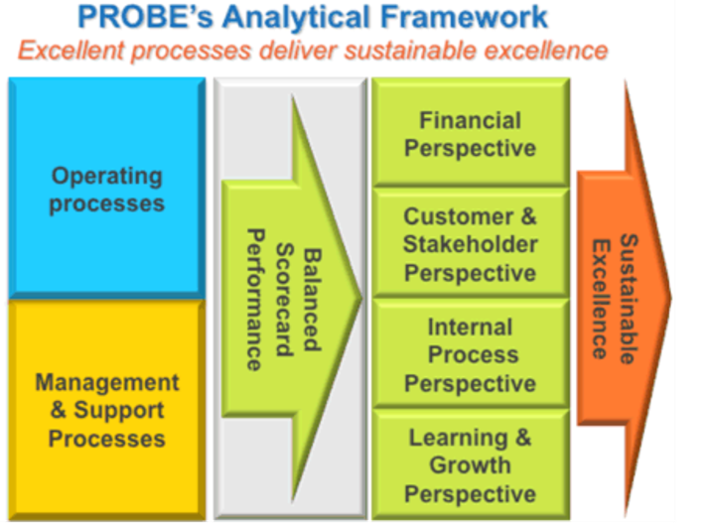
Achieving and sustaining world-class status is based on the proposition that adoption of best practice leads to strong operational performance, and in turn to superior business performance.
‘Practice’ refers to the processes that organisations have in place to design, manufacture, deliver and measure their products and services.
‘Performance’ refers to what is achieved as a result.
The analytical framework illustrates cause-and-effect relationships between:
- the processes at the heart of how the business functions, and the extent to which they support and embody excellence.
- performance across a range of perspectives, and the contributions to excellence that are apparent within that performance
[/vc_column_text][/toggle][toggle color=”Default” title=”PROBE More Information”][vc_column_text]PROBE testimonials – View Probe Network Testimonials
Download Probe Network “PROBE Explained” [pdf 994KB][/vc_column_text][/toggle][/toggles][/vc_column][/vc_row]